
Loving an Avoidant Partner: Free Guide
A free, downloadable guide for the partner of someone avoidantly attached — practical, research-backed ways to build closeness without chasing or losing yourself.

There is a quiet assumption that raising twins or triplets is simply “more” of the same experience.
More babies.
More love.
More responsibility.
But what often goes unspoken—and deeply under-recognised—is that parenting multiples is not just an increased version of raising one child.
It is an entirely different psychological experience.
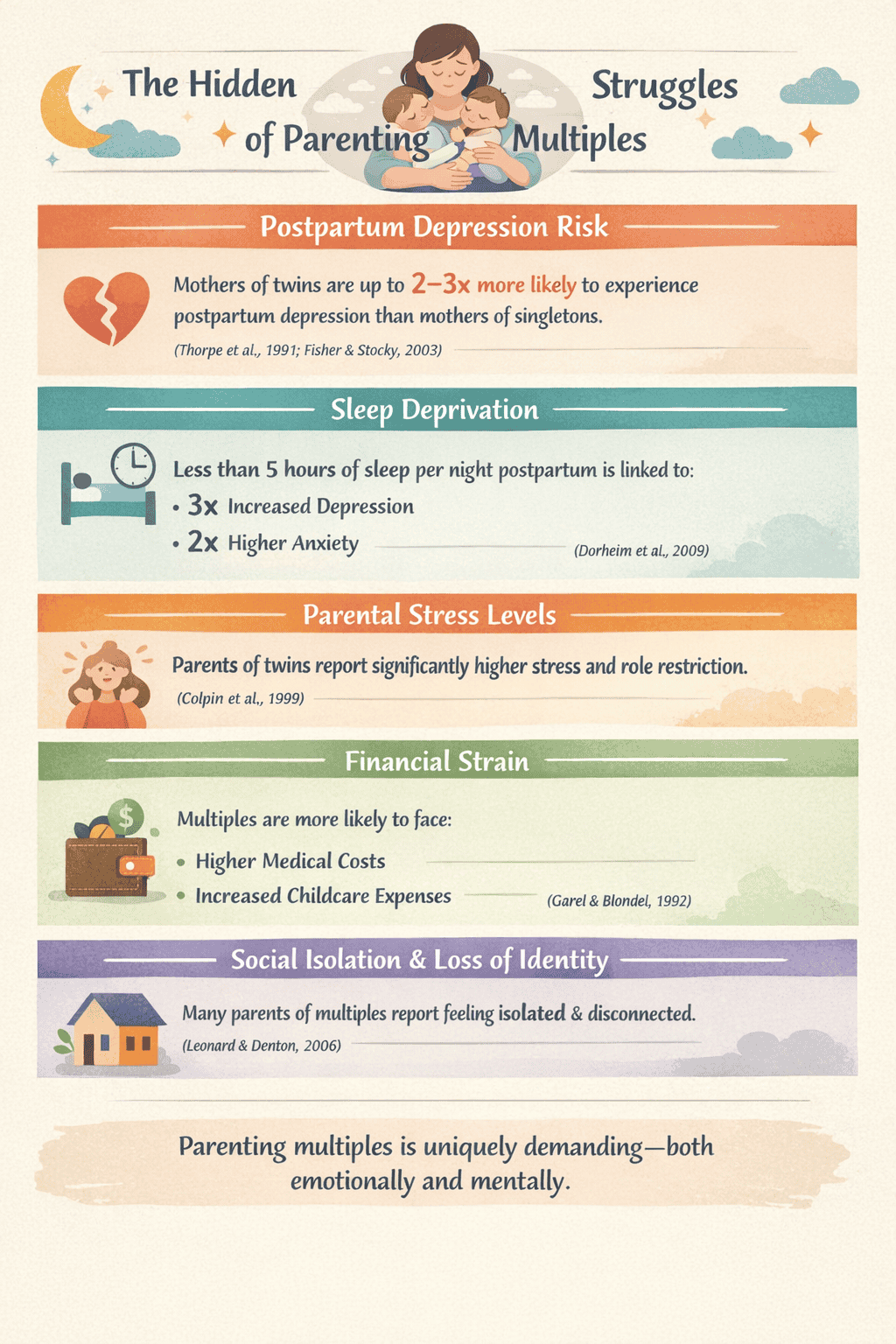
Research consistently shows that parents of multiples face significantly higher levels of emotional, physical, and mental strain, particularly in the early years. In fact, studies have found that mothers of twins are up to two to three times more likely to experience postpartum depression compared to mothers of singletons (Thorpe et al., 1991; Fisher & Stocky, 2003).
This is not because they are less capable.
It is because they are being asked to meet multiple, simultaneous needs—without recovery time in between.
And that changes everything.
One of the most important distinctions highlighted in research is this:
Parenting multiples is not additive.
It is compounding.
Unlike caring for one baby, where needs can often be met sequentially, parents of multiples are frequently required to respond to overlapping demands at the same time.
Studies using the Parenting Stress Index show that parents of twins report significantly higher levels of parental distress and role restriction, often comparable to families in high-risk categories (Colpin et al., 1999).
This sense of “role restriction”—feeling trapped, unable to pause, and constantly needed—becomes a defining part of the experience.
It is not just about doing more.
It is about never fully stepping out of the demand.
Sleep disruption is one of the most well-documented challenges for parents of multiples—and one of the most psychologically impactful.
Research shows that parents of twins experience:
(Kendall-Tackett, 2007)
This matters deeply because sleep is not just physical rest—it is emotional regulation.
Studies have found that sleeping less than 5 hours per night postpartum is strongly associated with:
(Dorheim et al., 2009)
For parents of multiples, this level of sleep deprivation is not occasional.
It is often continuous.
And over time, this creates a nervous system that is constantly operating in survival mode.
Multiple studies confirm that parents of multiples—especially mothers—face elevated mental health risks.
In addition, research suggests that these symptoms can last longer, as the intensity of care does not reduce as quickly as it often does with one baby.
This is not simply a “difficult phase.”
For many, it is an extended period of emotional depletion without sufficient recovery.
Another layer that significantly affects mental health is financial strain.
Multiples are more likely to be born prematurely, which increases:
At the same time, families face:
Research has consistently linked financial stress with:
(Garel & Blondel, 1992)
This creates a cycle where emotional stress and financial pressure reinforce one another, making it harder to access relief.
Beyond the visible challenges, there is also a quieter, more internal experience:
Isolation.
Studies exploring the lived experiences of parents of multiples describe:
(Leonard & Denton, 2006)
Many parents report feeling that their world becomes very small, very quickly.
And in that space, there is often little room to process emotions, reconnect with self, or feel seen outside of the caregiving role.
We’re saying the things out loud that needs to be said. If you are a friend or family member of someone with multiples, this is worth a read to gain a deeper understanding.
Most advice is shared with good intentions, but what often gets overlooked is that raising multiples is not a repeated experience—it is an entirely different rhythm of care, energy, and emotional demand.
Suggestions like “just follow a strict routine” can sound simple in theory, but in reality, one baby may be waking at different intervals while the other has entirely separate needs. There is no single predictable pattern to follow—only constant adjustment.
Many parents of multiples are already doing their best in real time, often with very little rest in between. In this context, advice can sometimes feel like added pressure rather than support.
What is often more helpful is not a solution—but an acknowledgement that the situation is already complex.
When a parent of multiples expresses exhaustion or overwhelm, it is not always a request for solutions. Often, it is simply an expression of emotion that needs space to exist safely.
Responses like “try this routine” or “have you considered…” can unintentionally shift the moment into problem-solving rather than emotional support.
But not every experience needs to be fixed.
Sometimes, what is needed most is simply:
“That sounds really hard.”
This phrase is usually shared with warmth and good intention. It is meant to encourage gratitude, which is often already deeply present.
However, when someone is expressing exhaustion or emotional overwhelm, it can unintentionally feel like there is no space allowed for difficulty.
Both truths can exist at the same time:
A parent can feel deeply grateful for their children and completely overwhelmed by the demands of caring for them.
What supports emotional safety is not redirecting the feeling—but allowing it to exist without guilt.
When people compare their experience to raising multiples—especially by saying things like “I had two close together, it’s basically the same”—it can land in a much heavier way than intended.
Because in that moment, it becomes very clear:
they don’t fully understand.
And that realisation can feel deeply isolating.
It can also bring up a quiet frustration—because there is often an internal pull to explain why it’s different, why it’s harder, why the comparison doesn’t quite hold.
Many mothers who have experienced both singletons and multiples have openly shared that raising multiples is significantly more demanding—not just in volume, but in intensity, overlap, and emotional load.
But trying to explain that can feel exhausting in itself.
There’s a hesitation:
Will this sound like complaining?
Will it come across as overdramatic?
Is it even worth trying to explain?
And so, many parents choose not to.
They nod. They smile. They move on.
But internally, it can feel like another moment of not being fully seen.
Because it’s not just about whether something is “harder”—it’s about the reality that this experience is fundamentally different.
And sometimes, what is needed most is not comparison—but simple acknowledgment:
“I don’t think I fully understand—but I can see that this is a lot.”
Support does not need to be large to be meaningful.
Holding one baby for a few minutes, bringing a meal, dropping off nappies, or simply sitting with a parent so they can pause for a moment can have a significant emotional impact.
What is often not fully understood is that many parents of multiples are living in a near-constant state of survival mode.
Advice like “sleep when the baby sleeps” or “just take a shower when they nap” doesn’t always reflect the reality. Because when one baby finally falls asleep, the other may still be awake—or struggling to settle. And by the time both are finally down, naps are often so short that the window to rest or reset disappears almost as quickly as it came.
It can become a continuous cycle:
one baby down, the other still needs something…
finally both down, and moments later, one is awake again.
There is rarely a true pause.
That is why even the smallest break—a few minutes to sit down, take a breath, or have a shower—can feel like a complete reset.
Not in a dramatic way, but in a deeply human one.
Like coming up for air after being held under for too long.
What may seem like a small gesture from the outside can feel like essential relief within the experience—because in a season where everything is constant, even a moment of stillness matters.
While there is often a focus on baby products, systems, or parenting strategies, the most impactful support is often human presence.
No product can replace the relief of being able to put a baby down safely while someone else steps in for a moment.
For example, when both babies are crying and basic needs like eating or resting have not been met, practical presence becomes far more meaningful than any item or solution.
Sometimes the most valuable support is simply someone saying:
“I’m here. Let me help you carry this moment.”
Feeding multiples is often spoken about as a matter of routine or organisation—but in reality, it is far more complex than simply “getting into a rhythm.”
For many parents of multiples, the journey starts very differently from the beginning.
A large number of multiples spend time in NICU, which means feeding doesn’t always begin with direct breastfeeding. Babies may need to be fed through bottles or tubes initially, often out of necessity rather than choice.
This alone changes everything.
From the very start, there can be added layers of pressure—trying to establish milk supply for more than one baby, while also navigating medical needs, recovery, and separation.
Then comes the transition.
Moving from bottle or tube feeding to breastfeeding can bring its own challenges—babies needing to learn how to latch, struggling to latch at all, or developing nipple confusion along the way.
It becomes less about routine and more about persistence.
For example, a parent may be trying to get one baby to latch while the other is already hungry, while also questioning whether both are getting enough milk, while also managing pumping, sterilising, and recovery.
It is not just feeding—it is coordination, emotional resilience, and constant adjustment.
This is why advice that simplifies feeding into schedules or systems can feel disconnected from reality.
Because for many parents of multiples, feeding isn’t just something to organise—it’s something to navigate, moment by moment, often with very little certainty.
And in that space, what is often needed most is not instruction—but understanding of just how much is being held at once.
Certain phrases are often said casually, but can linger emotionally far longer than intended.
Comments like “double the trouble” or “I’m glad that’s not me” may be meant lightly, but can feel heavy in moments of overwhelm.
Even well-meaning statements like “you’ll miss this one day” can create internal pressure when someone is struggling in the present moment.
For example, when sleep-deprived and managing two crying babies, being told to cherish the moment can feel more like expectation than comfort.
Most parents are not seeking perfect language—only gentleness and awareness.
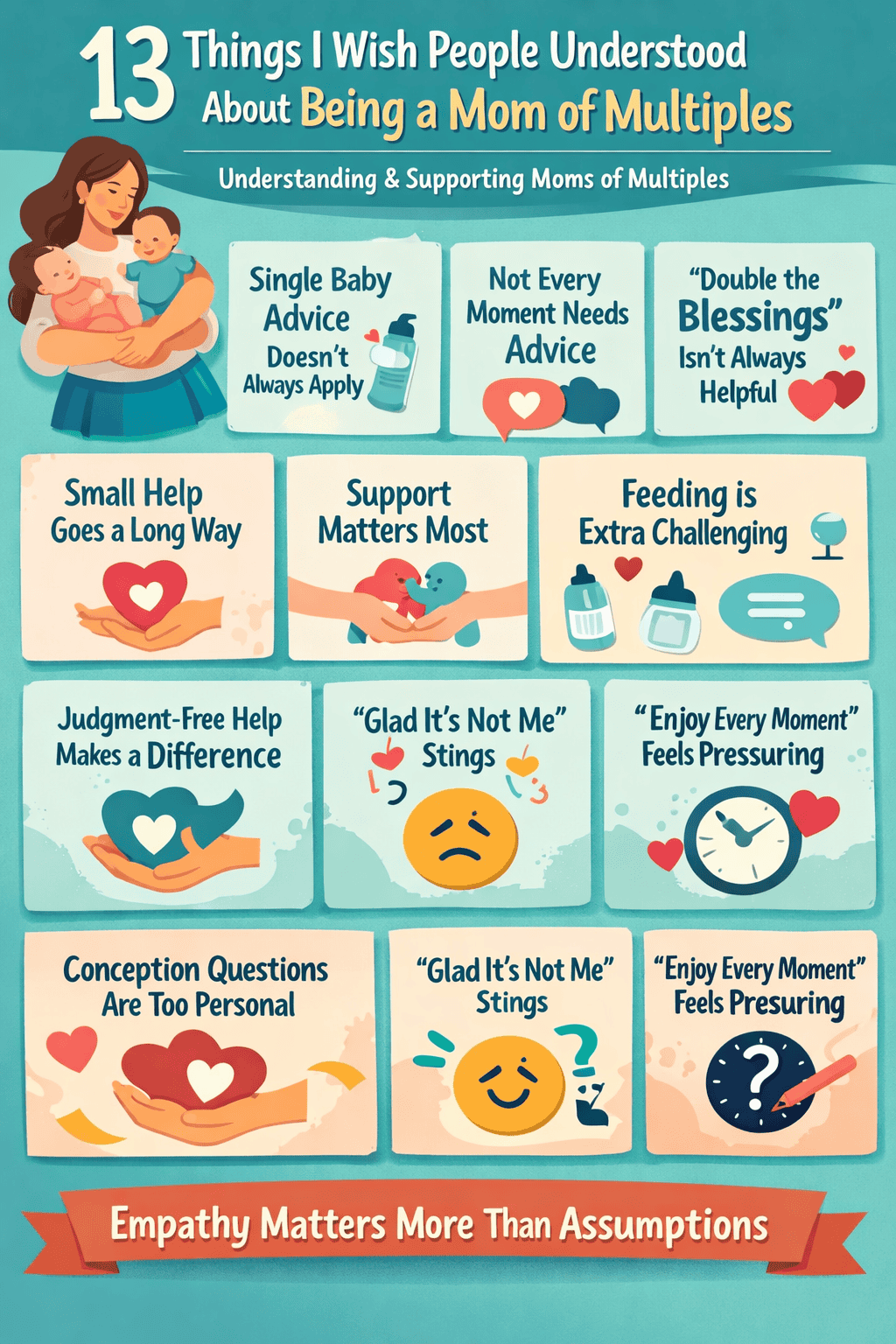
There is often quiet judgment attached to needing additional help, whether through family support, nannies, or night care.
However, what is not always visible is the level of exhaustion that leads to those decisions.
Caring for multiples can reach a point where support is not optional—it becomes necessary for sustainability and wellbeing.
One way to understand this is through something as simple as ratio.
With one baby, there are often two parents to one child. There is space to take turns, to rest, to hand over when needed.
With twins, that balance shifts immediately.
Even with an extra set of hands—another caregiver or full-time help—the ratio is still not equal. There are still more needs than there are available hands in many moments.
To truly “balance” the load in the same way a singleton might be supported, it would take four adults for two babies.
This isn’t about excess—it’s about perspective.
Because in reality, one person may be feeding one baby while another needs to be soothed, changed, or held at the exact same time.
For example, night support is often not about convenience—it can be what allows a parent to function safely, recover physically, and continue showing up the next day.
Support in this context is not a sign of failure. It is often what makes it possible to keep going.
What matters most is understanding rather than judgment:
“It makes sense that support is needed—and it’s a good thing that it’s there.”
This is often said casually, sometimes even as a joke—but it can leave a parent of multiples not knowing how to respond.
Because the truth is, there isn’t an easy or “correct” reply.
Agreeing with it—“yes” or “I wish it wasn’t me”—can feel ungrateful and may come across as inappropriate, even if it reflects a very real moment of exhaustion.
But responding with “no, it’s a breeze” or “I love every moment” doesn’t feel honest either. It can feel like having to minimise the reality of how hard things actually are.
So what often happens instead is a polite smile. A small laugh. An attempt to move the conversation along.
Not because the comment didn’t land—but because there isn’t space to respond truthfully without being misunderstood.
Moments like these can feel quietly isolating, not because of what was said alone, but because of how hard it becomes to respond authentically within them.
Sometimes what helps most is not putting someone in a position where they have to choose between honesty and being perceived as ungrateful.
This comparison is often shared with the intention of connection, but it can unintentionally minimise the lived reality of multiples.
While both experiences carry challenges, caring for children at different developmental stages is not the same as managing two infants whose needs occur simultaneously.
There is often no ability to alternate attention in the way people may assume—needs overlap continuously.
For example, one baby may be feeding while the other is crying for immediate comfort, both requiring full attention at the same time.
What often feels more supportive is acknowledgment rather than comparison:
“That sounds incredibly intense.”
These phrases are often shared with good intentions, usually coming from a place of nostalgia or perspective.
But for a mother of multiples, they can feel deeply disconnecting from the reality she is living in.
The truth is, the level of exhaustion and overwhelm is not just present—it is multiplied. Caring for more than one baby at the same time often means being physically stretched, emotionally drained, and constantly needed, with very little space to recover in between.
In that state, “enjoy every moment” can feel less like encouragement and more like pressure.
Because the reality is—most people would not enjoy being that exhausted, that overwhelmed, and that constantly needed.
And that doesn’t make someone ungrateful. It makes them human.
When these comments are said, they can quietly create guilt. Guilt for not feeling present enough. Guilt for not soaking it all in. Guilt for finding certain moments incredibly hard—sometimes even unbearable.
But the truth is, it is okay to not enjoy every moment.
It is okay to love your children deeply and still struggle with the intensity of the experience.
Some moments are beautiful. And some moments are simply about getting through.
And both deserve to exist without judgment.
Questions about how multiples were conceived are often asked casually, out of curiosity—but they cross a very personal boundary.
What is often overlooked is that this question is not neutral. It is, at its core, a question about someone’s body, their medical history, or their intimate life.
If the same question were directed at a parent of one child—“How exactly was your baby conceived?” or “What did that look like for you?”—it would immediately feel inappropriate.
Yet when it comes to multiples, there is often an unspoken assumption that this boundary no longer applies.
The reality is, it does.
Whether conception involved natural processes, medical intervention, or deeply personal circumstances, it is not information that needs to be explained to strangers, acquaintances, or even extended social circles.
Normalising this question simply because there are twins or multiples can unintentionally make parents feel exposed, as though their private experience is open for discussion.
Respect, in this context, looks like recognising that curiosity does not equal entitlement.
Not everything that is wondered needs to be asked.

While the challenges are real and well-documented, research also offers something equally important:
Protective factors matter—and they make a measurable difference.
Studies consistently highlight that the following significantly improve mental health outcomes for parents of multiples:
Perceived support is one of the strongest protective factors.
Parents who report:
experience lower levels of depression and stress (Golombok et al., 2004).
Even small acts of support have been shown to reduce psychological strain.
Research shows that when caregiving responsibilities are shared:
Strong partner involvement acts as a buffer against burnout.
Early psychological support—whether through therapy, support groups, or community care—has been shown to:
Yet many parents of multiples do not access this support, often due to time constraints or guilt.
Perhaps one of the most powerful (and often overlooked) protective factors is this:
Letting go of unrealistic expectations.
When parents are supported in:
they report greater emotional wellbeing, even in high-demand environments.
The research is clear:
Parenting multiples is not just a logistical challenge—it is a mental health experience that deserves recognition, support, and compassion.
And perhaps the most important shift we can make is this:
Moving from
“how do they manage?”
to
“how can we support them better?”
Because no parent is meant to carry that level of intensity alone.
Colpin, H., De Munter, A., Nys, K., & Vandemeulebroecke, L. (1999). Parenting stress and psychosocial well-being among parents of twins. Twin Research, 2(2), 101–108.
Dorheim, S. K., Bondevik, G. T., Eberhard-Gran, M., & Bjorvatn, B. (2009). Sleep and depression in postpartum women: A population-based study. Sleep, 32(7), 847–855.
Fisher, J., & Stocky, A. (2003). Maternal perinatal mental health and child development: A review of the literature. Australian and New Zealand Journal of Psychiatry, 37(4), 417–428.
Garel, M., & Blondel, B. (1992). Psychological consequences of having twins: A study of maternal mental health. Journal of Psychosomatic Obstetrics & Gynecology, 13(1), 21–28.
Garel, M., Salobir, C., & Blondel, B. (2007). Psychological consequences of having triplets: A longitudinal study. Human Reproduction, 22(5), 1260–1265.
Golombok, S., Cook, R., Bish, A., & Murray, C. (2004). Families created by assisted reproduction: Quality of parenting and child outcomes. Child Development, 75(3), 817–833.
Thorpe, K., Golding, J., MacGillivray, I., & Greenwood, R. (1991). Comparison of prevalence of depression in mothers of twins and singleton infants. BMJ, 303(6808), 875–878.

Disclaimer: All articles are reviewed and edited for quality control by a HPCSA Registered Counsellor. However, this content is intended to be used for educational and/or entertainment purposes and should not be taken as medical advice. Please reach out to a medical professional if you have concerns regarding your mental health.
A free, downloadable guide for the partner of someone avoidantly attached — practical, research-backed ways to build closeness without chasing or losing yourself.
Free, downloadable guide for the partner of someone with anxious attachment — research-backed ways to help without over-reassuring or losing yourself.
Free, downloadable guide for the partner of someone with disorganised attachment — research-backed ways to hold steady through the push-pull, without losing yourself.